
Inside Olivine #41: AI Won’t Replace Great Product Marketers
From our team to yours: what AI can take off your plate, what still needs real judgment, plus open roles and a few other picks worth your time.


A note from the team
Every PMM we talk to is using AI. Fewer of them have figured out where to stop.
That’s the question running through this issue: which parts of the job AI can genuinely take off your plate, and which parts still need a person with real judgment behind them. We’re also sharing some open roles to check out, a client win, and a tool and template worth adding to your stack.
Onward.
AI Won’t Replace Great Product Marketers
AI has changed product marketing permanently. Summarizing interviews, writing copy, researching competitors and markets: work that used to take hours now takes minutes. That doesn’t make product marketers less valuable. It changes what they’re valued for.
Execution is becoming commoditized. Judgment is not. AI isn’t taking product marketing jobs from strong PMMs. It’s coming for mediocre ones.
Where AI actually earns its keep
AI is a great assistant, not a replacement. It’s excellent at processing information. The trouble starts when that information needs to be interpreted, prioritized, and turned into strategy.
Take interview summaries. On a recent project building 20+ personas across two business units, AI summarized dozens of stakeholder and customer interviews in minutes, saving hours of admin work. But the summaries didn’t tell a story. Reading the actual transcripts surfaced the golden nuggets AI completely missed. AI summarized what was said. It didn’t understand what mattered. The final personas were built from experience and judgment, not AI summaries.
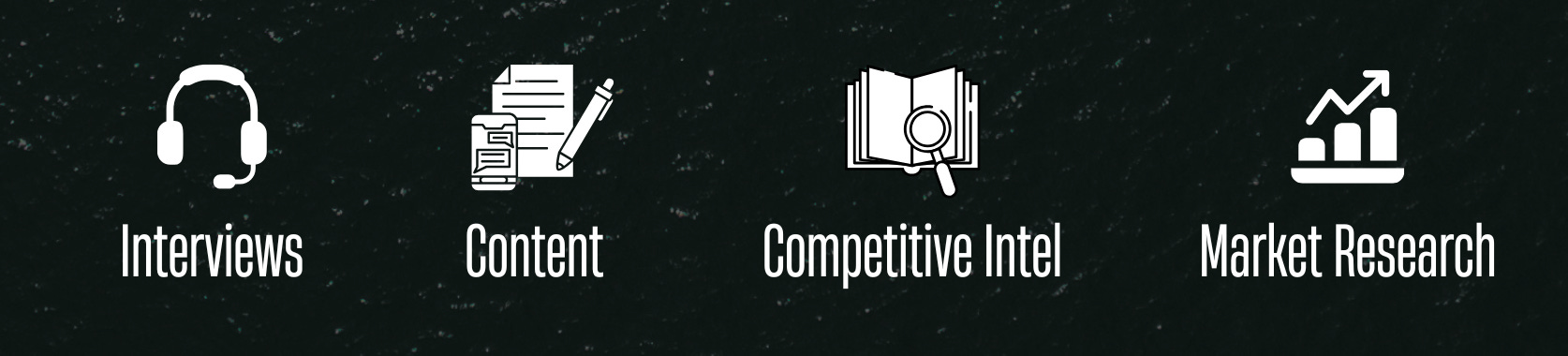
The same pattern shows up everywhere: AI drafts copy fast, but the language is often generic enough that every company in a category starts to sound the same. It can map competitors and generate SWOTs, but it can’t tell you which adjacent product sales keeps losing deals to. It can get a PMM up to speed on a new market, but “learn” is only the first step of learn, do, teach. AI helps with the first one.
Where AI still falls short

Safe positioning. AI optimizes toward consensus, so it produces a balanced, reasonable answer that offends no one. Strong positioning isn’t balanced. It makes choices about who the product is for, who it isn’t, and which hill is worth dying on. That takes conviction, and conviction still comes from people.
Broad ICPs. AI-generated ideal customer profiles tend to look remarkably similar to each other: logical, defensible, and hard to argue with. The best ones come from win/loss data, NPS, and customer success stories, not industry descriptions.
Pleasant, forgettable messaging. AI-generated messaging tends to sound nice: optimistic, complimentary, conflict-averse. Real products have real gaps, tough pricing, and crowded categories. The companies that stand out rarely have the safest messaging. They have the clearest point of view, and AI isn’t very good at having one.
Reality over hype. Left alone, AI tends to overstate strengths and underplay weaknesses. The strongest PMMs build trust by being honest about limitations, not smoothing them over. Credibility beats smoke and mirrors
The move
Every product marketer should be using AI. The advantage now comes from knowing where to stop. Use it to summarize interviews, but read the transcripts. Use it to draft messaging, but write the positioning yourself. Use it to research competitors, but validate the findings.
TL;DR AI has commoditized execution in product marketing, not judgment. It’s a strong first pass for interview summaries, copy drafts, and competitive or market research, but it still can’t take a real position, build ICPs from lived experience, or tell the truth about a product’s weaknesses. The PMMs who use AI to clear out repetitive work, and spend the time they save on judgment, are becoming more valuable, not less.
PMM Toolkit: Tool, Template, Trend
🛠 Tool: Profound
Profound tracks how your brand shows up across ChatGPT, Perplexity, Gemini, Claude, Copilot, and Google AI Overviews, showing you exactly which prompts surface your brand, how you’re being described, and where competitors are winning the citation instead.
Why PMMs use it: as more buyers start their research inside an AI answer instead of a search results page, knowing whether your product even gets mentioned (and how) is becoming as core to the job as tracking rankings or web traffic.
📄 Template: Internal Product Positioning & Messaging Guide
One of our own Playbook templates: a structured guide for documenting your product’s mission, vision, ICP, differentiators, and messaging pillars in one place.
Best used as the human-written foundation this issue keeps coming back to. Let AI draft around it, but make sure the positioning itself, the point of view, the tradeoffs, the conviction, comes from your team first.
📈 Trend: Answer engines are becoming a visibility channel of their own
SEO used to be the finish line. Now it’s one stop among several, as buyers increasingly get their first impression of a product from an AI-generated answer rather than a list of blue links.
That shift, often called answer engine optimization (AEO) or generative engine optimization, rewards brands with clear, structured, citable content and a track record of being talked about accurately elsewhere. It’s less about gaming a new algorithm and more about making sure your positioning is consistent and well-documented enough that an AI model can repeat it correctly.
PMMs who start monitoring how their product gets described in AI answers now will have a head start on a channel that’s only going to matter more.
Inside Olivine
📣 Confidential search: Senior Manager, Product Marketing

We’re running a search for a Senior Product Marketing Manager for a Series B endpoint security startup.
If you have experience with an endpoint, MDM, or device-security product, then this is your chance to own the positioning and narrative from end to end. No dependency on other teams or drawn-out review processes. You’ll be working directly with the leadership team to set the strategy and drive execution.
You’ll own:
Company-wide positioning, messaging, and buyer personas
Competitive intelligence, battlecards, and win/loss analysis
The entire sales enablement library (one-pagers, decks, case studies, objection handling)
The DIB/CMMC narrative specifically, from white papers to executive bylines
Who fits: a product marketer first, not a generalist content person. Endpoint, MDM, or device-security experience is ideal, and any exposure to defense, federal, or regulated markets is a bonus.
📍Remote (US) | 💰$130k–$150k base + bonus | 🕐 5-8+ years B2B PMM experience
Client happenings

The SambaNova team announced the first close of its $1B Series F financing at an $11B valuation, led by General Atlantic, with participation from new and existing investors. Huge congrats to the team, we’re grateful to be part of the journey!
Open marketing roles in our network
Looking for your next opportunity? Here are a few open remote and in-person marketing and GTM roles from companies in our network.
Senior Manager, Product Marketing @ A Series B cybersecurity company
Performance Marketing Manager @ Kustomer
Marketing Coordinator @ DBM Vircon
Senior Manager, Product Marketing - Telecommunications @ ServiceNow
Product Marketing Manager @ Trimble
Sr. Principal Product Marketing Manager @ Siteimprove
Head of Field Marketing & Strategic Events @ Workvivo (acquired by Zoom)
Thanks for giving this a read! Until next time,
The Olivine Team 🥳